
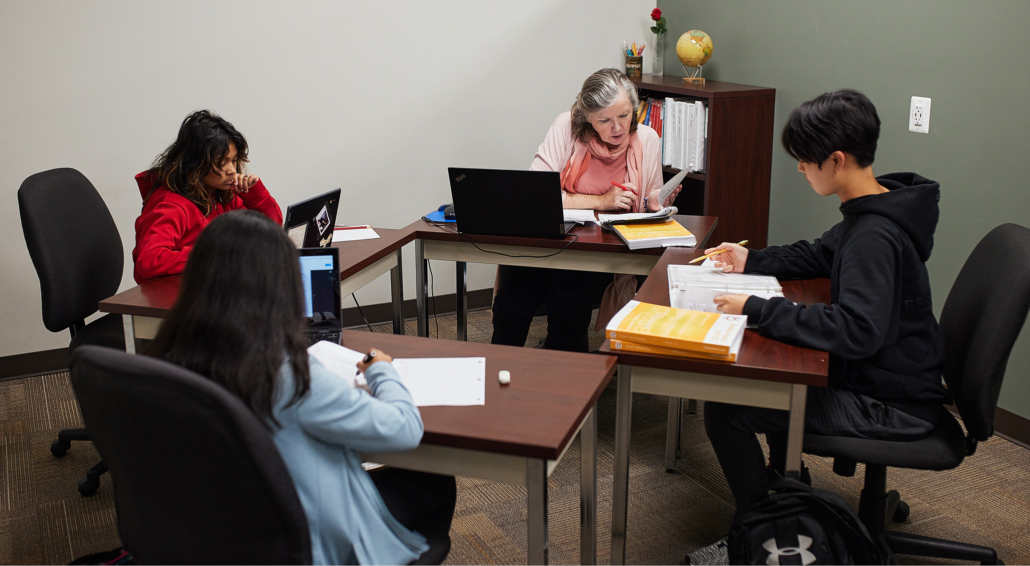
Students across the country are struggling to regain academic ground continuing a trend that started before the pandemic.
Reading and math performance has declined across much of the United States over the past decade, leaving families, educators, and policymakers asking an increasingly important question: What actually helps students improve?
A recent New York Times analysis of 30 ideas for improving U.S. schools offers an interesting answer.
The Times asked 37 education academics and researchers to evaluate strategies ranging from increasing school funding and reducing class sizes to changing curriculum and limiting technology use.
At the top of the list? Small-group tutoring.
The big caveat from the research is that any of the solutions needed to be implemented properly and with a high level of quality.
So what does effect small group tutoring look like?
In This Article, We’ll Cover:
- Why did small-group tutoring rank so highly?
- Why does group size matter?
- What should parents look for in a tutoring program?
- How does C2’s approach align with those qualities?
- What could the findings mean for your student?
Why Did Small-Group Tutoring Rank So Highly?
In the New York Times expert survey, small-group tutoring earned an effectiveness score of 6.0 out of 7, the highest among all 30 strategies evaluated.
It ranked ahead of universal pre-K, increased per-student funding, expanded access to advanced classes, high-quality curriculum, smaller class sizes, and technology-based personalized learning.
The Times defined small-group tutoring as “students meeting in groups of three or four with the same tutor during the school day at least three times a week”.
That model highlights several characteristics worth noting: small groups, consistency, frequency, and targeted academic support.
Those elements can give educators more opportunities to identify what students understand, recognize where they may need additional support, and adjust instruction accordingly.
Small-Group Tutoring Isn’t the Same as a Smaller Class
One of the most interesting findings from the analysis is the difference between small-group tutoring and simply reducing class size.
Small-group tutoring ranked first for effectiveness, with a score of 6.0. Reducing class sizes received an effectiveness score of 3.8.
A smaller classroom is still a classroom. Teachers must deliver curriculum to a group of students who may have very different strengths and academic needs where as tutoring can be more targeted.
Instead of asking, “What does this class need to learn today?” effective tutoring can focus on a different question:
What does this student need next?
A student struggling with Algebra II, for example, may actually have an earlier gap in algebraic skills. A student having difficulty with reading comprehension may need targeted work on vocabulary, inference, or identifying evidence. A student earning strong grades may be ready for enrichment or more advanced coursework.
As we discuss in our guide for parents to identify when it may be time to hire a tutor, tutoring can be both reactive and proactive. Students don’t necessarily need to wait until grades decline to benefit from additional academic support.
Why Group Size Matters
There is a reason “small group” is an important part of small-group tutoring.
The goal isn’t simply to recreate a classroom with fewer students. The group needs to be small enough for an educator to provide meaningful individualized attention.
At C2 Education, sessions are conducted in a 3:1 student-to-tutor setting, giving students opportunities to work directly with a tutor as well as time to apply what they have learned independently.
That balance matters because students ultimately have to perform independently, whether they’re completing an assignment, taking a classroom exam, sitting for the SAT or ACT, or eventually navigating college coursework.
The goal of tutoring isn’t to make a student dependent on a tutor. It’s to provide the support they need while strengthening their ability to succeed on their own.
Tutoring Can Be Proactive, Not Just Reactive
The national conversation around tutoring often focuses on students who have fallen behind.
However, students can benefit from additional support to continue to be challenged and advance at an accelerated pace.
As our article on when to hire a tutor explains, proactive tutoring can help students prepare for new concepts, upcoming coursework, and major exams, while reactive tutoring can address existing challenges such as declining grades or difficulty in a particular subject.
This creates a more useful question for families than:
“Is my student struggling enough to need tutoring?”
Instead, consider:
“What does my student need to accomplish next, and do they have the support to get there?”
C2’s K–12 tutoring programs support students across subjects including math, science, English, history, and more, as well as preparation for standardized and advanced academic exams.
What Makes Tutoring Effective, and What Should Parents Look For?
The Times analysis comes with an important caveat: researchers rated each intervention based on its effectiveness when implemented properly and at high quality.
So the takeaway isn’t simply that tutoring works.
It’s that the quality of the tutoring matters.
For families evaluating their options, that means looking beyond the word “tutoring” and asking how a program actually supports the student. A few helpful questions to guide your search include:
Does the program identify where the student is starting?
Effective support begins with understanding what the student knows, where gaps may exist, and what they’re working toward.
At C2, we begin with a diagnostic assessment and consultation to make sure we understand exactly where each student is in their mastery of a subject area before creating an academic plan. This way we make sure that the academic support we provide is personalized around each individual student’s needs and goals.
Is instruction adjusted to the student?
A student’s needs can change over time.
An elementary student working on reading comprehension may later be ready for more advanced material. A middle school student strengthening math fundamentals may eventually shift toward Algebra I. A high school student focused on grades may later need support with AP coursework, SAT or ACT preparation, or college planning.
At C2, we work with families regularly and adjust the academic plan as the student’s needs and goals change.
Will my student receive meaningful individual attention?
Group size matters.
Our 3:1 student-to-tutor ratio creates opportunities for direct instruction, questions, and feedback while also giving students time to practice independently.
That independent work is intentional: students need to be able to apply what they’ve learned when an educator isn’t sitting beside them.
Does the support connect to broader academic goals?
Tutoring shouldn’t exist in isolation from the rest of a student’s academic journey.
We support students from elementary school through high school, allowing academic tutoring to connect with changing goals, from foundational skills to increasingly rigorous coursework and college admissions.
How will I know if the plan needs to change?
Personalization shouldn’t happen only at the beginning.
Effective academic support requires paying attention to progress and adjusting as the student’s needs evolve. The objective isn’t simply to spend more time on schoolwork; it’s to make that time purposeful.
These are the kinds of questions parents should ask of any tutoring provider. The Times’ analysis reinforces why they matter: the intervention itself is only part of the equation. Quality and execution matter, too.
What Does This Mean for Your Student?
National statistics can tell us there is a problem. They can’t tell you what your student needs.
That’s where the conversation should start.
Your student may need to close a learning gap, strengthen a foundational skill, prepare for more challenging coursework, improve a grade, get ready for an important test, or simply be challenged beyond what they’re currently doing.
The right tutoring should start with that need, not with a one-size-fits-all solution.
At C2 Education, we start with the student and build personalized academic support around where they are and where they want to go.
The New York Times expert survey adds to the evidence supporting small-group tutoring as a powerful academic intervention. For families, the next question is simpler:
What could the right support help your student accomplish next?
Frequently Asked Questions
Does research show that small-group tutoring is effective?
In its September 2026 analysis, The New York Times asked 37 education academics and researchers to evaluate 30 ideas for improving academic achievement. Frequent small-group tutoring received the highest effectiveness rating of the interventions evaluated, with a score of 6.0 out of 7.
The survey asked experts to assume each intervention was implemented properly and at high quality, making quality of implementation an important part of interpreting the results.
How many students are in C2 tutoring sessions?
C2 sessions use a 3:1 student-to-teacher ratio. This small-group structure gives students opportunities for individualized attention from an educator as well as independent work.
Is small-group tutoring the same as having a smaller class?
No. Small-group tutoring provides targeted academic support to a very small number of students. In the New York Times expert survey, small-group tutoring received an effectiveness rating of 6.0, compared with 3.8 for reducing classroom sizes.
Is tutoring only for students who are behind?
No. Tutoring can help students address academic challenges, but it can also provide enrichment, preparation for advanced coursework, and proactive support before problems emerge. C2’s K–12 tutoring programs are personalized around students’ individual academic needs and goals.
When should parents consider tutoring?
There isn’t one universal trigger. Changes in grades, difficulty understanding new concepts, frustration with homework, ineffective study habits, or preparation for more demanding coursework can all be reasons to explore additional support. Learn more in our guide to when to hire a tutor.
What subjects does C2 Education offer tutoring for?
C2 provides tutoring across a wide range of K–12 subjects, including math, science, English, history, and foreign languages, along with preparation for the SAT, ACT, AP exams, and high school entrance exams. Visit our K–12 tutoring page to learn more.